Showing posts with label bull trout. Show all posts

Monday, February 22, 2010

U.S. Fish and Wildlife Service Examines Bull Trout Habitat

The bull trout is one of Montana’s most unique fish. They can grow to over three feet and can weigh over 20 pounds, and depend on cold, clear water. Bull trout are excellent indicators of water quality, and are often considered an “umbrella” species. That is, if water quality is healthy enough for bull trout, it is likely healthy enough for most other, less-sensitive aquatic species native to Montana. Their sensitivity to adverse water conditions, coupled with the competition posed by non-native fish such as the brook trout, have caused bull trout numbers to slowly decline across the northwest, and they were listed as a threatened species under the Endangered Species Act (ESA) in 1998.


On January 13, the U.S. Fish and Wildlife Service proposed to revise its 2005 designation of critical habitat for the bull trout. Under the ESA, critical habitat identifies geographic areas essential for the conservation of a listed species. Critical habitat designations provide extra regulatory protection to areas that may require special management considerations, and the habitats are then prioritized for recovery actions. The critical habitat designation does not affect land ownership, does not allow government or public access to private lands, and does not impose restrictions on non-federal lands unless federal funds, permits or activities are involved. However, it alerts landowners that these areas are important to the recovery of the species. In the Clark Fork Basin, as restoration continues on mining-impacted ecosystems, maintaining quality bull trout habitat can be seen as a final hurdle; if bull trout return to some of the historically damaged areas of the Clark Fork watershed, then we can safely assume that restoration efforts are succeeding.

In total, the Service proposes to designate approximately 22,679 miles of streams and 533,426 acres of lakes and reservoirs in Idaho, Oregon, Washington, Montana and Nevada as critical habitat for the wide-ranging bull trout. The proposed revision comes after extensive review of earlier critical habitat proposals and public comments. The Service voluntarily embarked on this re-examination to ensure that the best science was used to identify the features and areas essential to the conservation of the species.

In Montana, additional bull trout critical habitat is proposed for the Kootenai, Clark Fork and St. Mary River Basins. Under the 2010 proposal, most tributaries of the Blackfoot River, Flint Creek and the Clark Fork River would be considered critical bull trout habitat. Most of the Blackfoot, as well as sections of Flint Creek and the Clark Fork, were previously designated as critical bull trout habitat in 2005.

The Clark Fork and Flathead watersheds were historically important to bull trout prior to the heavy impacts caused by human developments such as hydroelectric dams, other manmade barriers, and historic mining. Today, those river systems are being reconnected through dam removal (Milltown Dam), improved fish passage (Cabinet Gorge, Noxon Rapids, Thompson Falls), and improved habitat (Clark Fork restoration projects). The Clark Fork River is particularly important, as it provides a migratory corridor for bull trout from Lake Pend Oreille and the lower river to access the Blackfoot, Rock Creek, and potentially Flint and Warm Springs Creeks, where significant populations of bull trout remain.

To do our part to help bull trout recover, anyone fishing in western Montana should repeat the mantra: No Black, Put It Back! Bull trout are most easily distinguished from other Montana trout by their top fin; unlike other trout, the bull trout have no black spots on their top fin. They are also characterized by a slightly forked tail and pale yellow, orange and red spots on the body. As a threatened species, bull trout should be released immediately if caught. To assist in identifying Montana trout, CFWEP, Montana Fish Wildlife & Parks, the Sierra Club, and the University of Montana distribute free pocket fish ID guides. Contact CFWEP for your free guide before heading out on the river.

The Service will accept public comments on the proposed critical habitat until March 15, 2010. For information on how to submit a public comment, and for more on the proposed critical habitat designation, visit www.fws.gov/pacific/bulltrout. For a direct link to a map comparing existing bull trout critical habitat with proposed 2010 habitat, click here. You can learn more about bull trout in Montana at the Montana Field Guide from mt.gov.
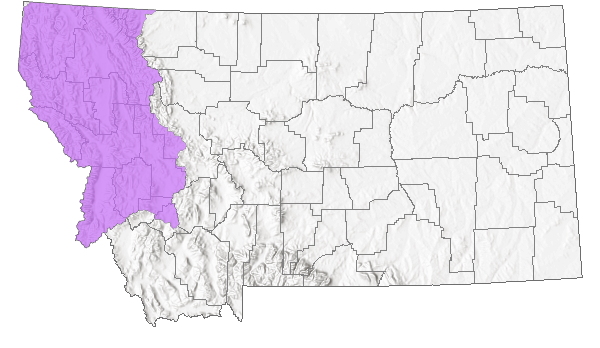

The above map shows bull trout range in Montana.
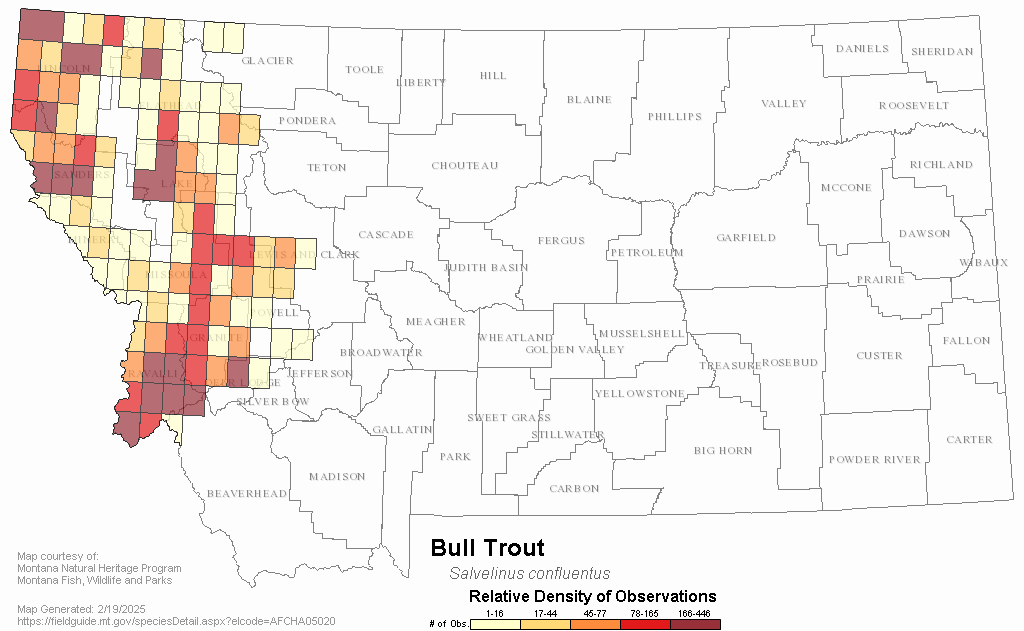
The above map shows bull trout density in Montana.

Thursday, November 6, 2008

Westslope trout found in Restored Silver Bow Creek


In the restoration of Silver Bow Creek,
the word “progress” can be essentially defined with the recent capture of two native Westslope cutthroat trout in its flows this October. While barely enough to fill one fisherman’s stomach (if keeping westslopes were legal, of course), the presence of these two fish speaks volumes to the likelihood that a stream long-revered as one of the West’s most contaminated waterways has hope in establishing a future fishery, if things continue down the same, right path.

It’s noteworthy to mention that while the trout found in the creek this fall are certainly remarkable, the ongoing and previous restoration across the floodplain has been very successful to date, most notably judged by the exceptional increase in vegetation diversity and the presence of various waterfowl, shore and song birds, deer, moose, and even elk frequenting the area. What is particularly significant about the discovery of the two Westslopes during the annual electrofishing count on Silver Bow Creek is that they were collected in a location several miles away from the closest “clean” tributary supporting a healthy Westslope population.

In the past, brook trout have been found during the annual fisheries monitoring, but never Westslopes, and what’s more, never so far away from one of the uncontaminated tributaries, like Browns Gulch and German Gulch creeks. Westslope cutthroat can serve as an “umbrella species” in an ecosystem – if there are Westslope cutthroat trout thriving, then everything else in the ecosystem must be relatively well too – another piece of evidence that all is going as planned in the ultimate restoration of Silver Bow Creek.
This is exciting news as the project moves closer to completion (the remediation and restoration of Silver Bow Creek is now expected to be finished by the end of 2011). It’s also important news in light of some recent monitoring data that shows metals recontamination occurring in some of the upper reaches of the restored stream. Greg Mullen, the restoration project manager for the Natural Resource Damage Program, stated the following in light of the recent trout findings: “Once the wastewater treatment plant (Butte’s Metro Sewer municipal sewage treatment plant, which discharges high volumes of nutrient-laden water to the creek) is cleaned up, then we should see more trout in Silver Bow Creek.”


Perhaps the biggest thing for the public and others to remember when judging restoration projects of this magnitude is that it takes a significant amount of time for a stream to return to an uncontaminated condition after more than a century of intense abuse and misuse. The remediation and restoration of Silver Bow Creek started in 1999; it wasn’t until 2008 that the first native trout were found swimming in its restored reaches. One of the remedial goals of the project from the mid-1990s was to reestablish a self-sustaining native Westslope fishery in Silver Bow Creek. Well, it’s nine years later and we’re getting there.

In restoration, it’s the destination, not so much the journey, that needs our greatest attention. There are lots of ups and downs along the way, but keep in mind that the end of the road will take us to a better, cleaner place.

Another good example and case for this reminder is the Milltown Dam and Sediments Removal remediation and restoration project, 120 miles downstream at the Clark Fork’s confluence with the Blackfoot River. With the breaching of the dam last March, there has been a significant amount of sediment, some containing arsenic, that washed downstream of the project, allegedly impacting the middle Clark Fork fishery and macroinvertebrate populations, not to mention the reservoir at Thompson Falls another 100 miles downstream. Regardless of these short-term impacts, the important thing to remember again is that restoration takes time.
The Clark Fork-Blackfoot confluence has been hidden and contaminated behind and beneath the Milltown Dam and Reservoir for 100 years. This integral link between big river ecosystems was just reconnected in March of 2008 and while there are some short-term impacts that might not be as positive as we’d like to see, there are thousands and thousands of fish and their future generations already much, much happier, even in the murk of some extra sediments.


Of course it would be foolish not to look closer at short-term data that shows problems, especially if the problems are ones that can and need to be addressed. The data showing recontamination of restored Silver Bow Creek tells that there is still significant work left to be done on the Butte Hill; the Milltown sediments loading since the breaching signifies that additional erosion and sediment control measures may need to be in place before the Spring 2009 runoff. But it’s just as foolish for one to expect that fragile and complex ecological systems like those being restored are going to improve overnight or, likewise, to sound the alarm of failure at the earliest signs of negative data. Again, not to belabor the point, it took our predecessors more than a century to put this watershed in the condition that required the current cleanup; it is certainly possible that it could take decades before things are fully restored, depending on the definition of restoration.

But the rewards of a revitalized watershed are as great as any mother lode.
Who knows? Maybe in some of our lifetimes, the trout swimming in Silver Bow Creek might be the same trout that swam past the confluence of the Blackfoot and Clark Fork to spawn.

The Salish-Kootenai and Pend d'Oreille peoples’ historic name for the confluence area was “the place of the big bull trout.” While at this point in time, we should relish in the simple discovery of the Westslopes returning to the most contaminated reaches of the Clark Fork system, it certainly might be feasible that in future generations the words of the native people could again come true. After all, “if it can be recalled, it can be restored.”

We have a vision, a plan and a mission underway to clean up the Clark Fork watershed from its damaged condition. But what we also need to have, as much as or maybe even more than anything else, is patience.

As the end of the 2008 construction season closes on Silver Bow Creek, let’s have a look at the progress to date and the work to be performed in the near future: Volume of contaminated materials removed: 3,700,000 cubic yards
Miles of stream remediated and restored: 10 miles
Acres of floodplain remediated and restored: 950 acres
Percentage of Total Project Completed: 70%
The Next Six Months:
A new stream and floodplain will reach from Butte all the way downstream to the railroad trestles at the upstream end of Durant Canyon;
Almost one mile of new stream will be completed in the beginning reach of Subarea 4 (near Opportunity/MT Hwy 1);
The bid package for the first 2.5 miles of the Durant Canyon cleanup section will be released.

Tuesday, May 13, 2008

Identifying Montana Trout

This blog entry comes to you courtesy of Bader Consulting, mbader@montana.com, with fish art copyright Joseph Tomelleri, courtesy Montana Fish, Wildlife & Parks.


The Bull Trout (Salvelinus confluentus) is Montana's largest migratory trout and is protected as a Threatened Species. The Montana record is 26 pounds, yet even larger fish are likely. In late Summer bull trout begin epic spawning journeys up to 100 miles. They are sensitive to changes in habitat and require colder, cleaner water than other native fish.


The Westslope Cutthroat Trout (Oncorhynchus clarki lewisi) is classified as a "sensitive" species in Montana. Once abundant, "pure strain" cutthroat (not inter-bred with other species) are now restricted to 5% of their former range. They are most often located in headwaters streams and high mountain lakes. The state record is 16 pounds from Red Eagle Lake.


Rainbow Trout (Oncoryhnchus mykiss) are relatively abundant in Montana's cold water rivers, streams and lakes. Their name comes from the colorful stripe running the length of the body. The Montana record is 33 pounds, from the Kootenai River. Rainbows often interbreed with cutthroat trout. The record hybrid is 33 pounds from Ashely Lake.


Brown Trout (Salmo trutta), also known as the German Brown, is a large trout which spawns in the fall. They take their name from the brown-yellow color of their bodies. Attaining large size, the Montana record is a 29 pound fish from Wade Lake.


The Brook Trout (Salvelinus fontinalis) is a non-native fish and the smallest of the trout species. The Montana record is 9 pounds from Lower Two Medicine Lake. They are most often found in smaller tributary streams. Brook trout have displaced native trout from the lower reaches of many streams. Since they are chars, they can interbreed with native bull trout, often resulting in sterile offspring.

Use These Good Trout Fishing Practices:

Know Your Fish
Know the regulations for your location
Use single, barbless hooks
Avoid fishing in hot weather & high water temps
Practice quick release techniques

For More Information, visit:

http://fwp.mt.gov/education/fishingeducation

www.sierraclub.org/sierrasportsmen